
Canton is maturing, and the questions are getting harder
Canton has crossed from experiment to production financial infrastructure. Real institutional assets and operations are live on the network, and that raises the operational standard every application is measured against. Before institutions commit, they tend to ask a simple question: what happens if one operator goes offline? An application that runs on a single node, or even two, cannot answer that convincingly. A single operator is a single point of failure, and for regulated capital that is a reason to wait. Regulated institutions run internal vendor risk checks that require multiple fallbacks, precisely so their own end clients never experience an outage. An application without that redundancy built in fails the check before the conversation even starts.
What Decentralization Manager does
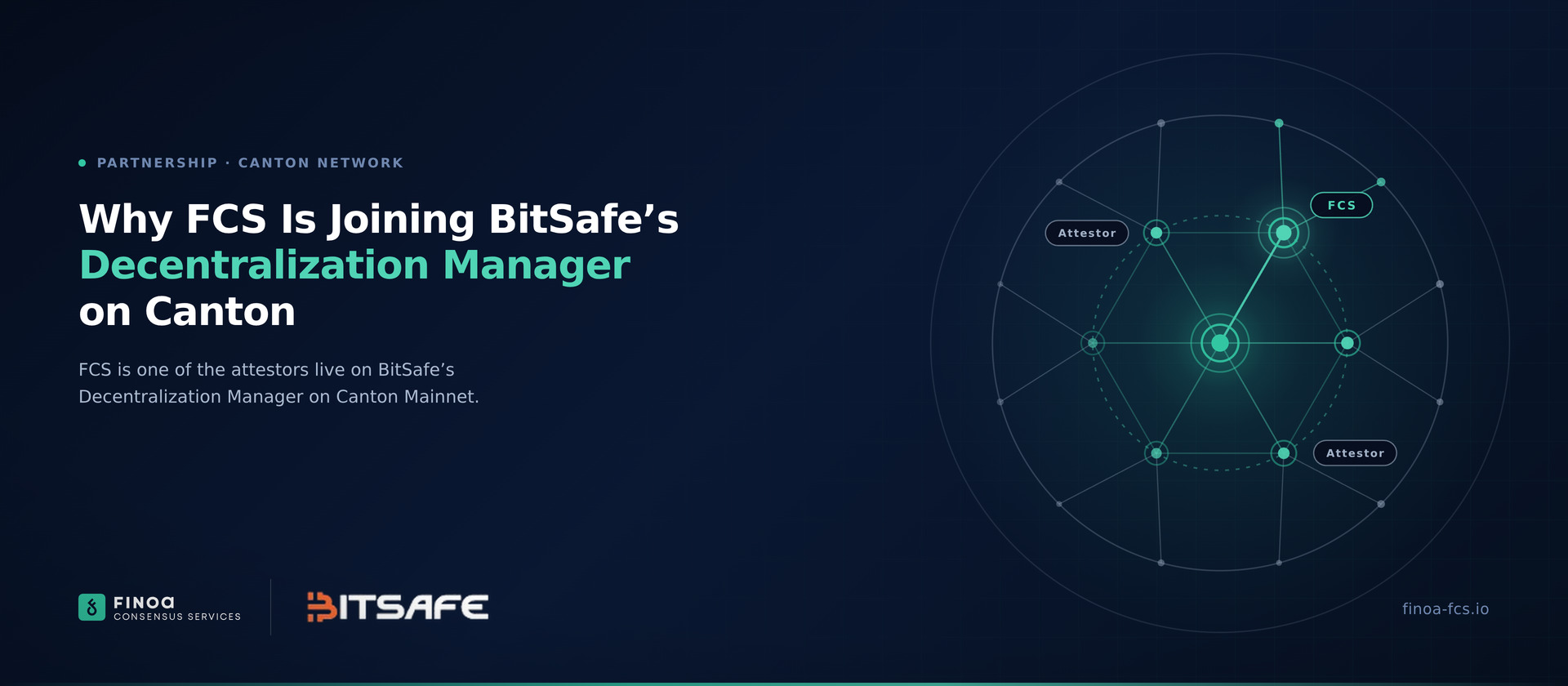
BitSafe's Decentralization Manager is the open-source application that makes it possible to join a Decentralized Party: a group of independent operators sharing a single onchain function, so the loss of any one of them doesn't take the application down. It coordinates the operators involved, keeping the group functioning even when individual nodes go offline, rotate, or fail.
For teams building on Canton, the benefit is redundancy without the engineering lift. Assembling a decentralized party and coordinating a group of independent, reliable operators takes months of specialized work and expertise. BitSafe's Decentralization Manager accelerates that process with easily-installed infrastructure.
The application has been audited by Quantstamp. It is already proven in production: BitSafe's CBTC runs on a Decentralized Party on Canton MainNet, with over 35 million transactions since launch.
Why FCS is participating
Finoa Consensus Services already operates on Canton as one of the network's Node-as-a-Service Providers. We already participate in a Decentralized Party today: we serve as one of the attestors for CBTC, helping it reach that transaction volume without incident because of the redundancy that structure provides. Decentralized Parties are a natural extension of that role: they depend on exactly the kind of independent, reliable operators we already are.
What this means for teams evaluating Canton infrastructure
If you are weighing how to build resilient, institution-ready infrastructure on Canton, the operational lift just dropped. You no longer have to assemble an operator network from scratch or spend months coordinating redundancy before you can launch. You install Decentralization Manager, and operators who are already running, FCS among them, can join your Decentralized Party. The redundancy institutions expect now takes a single setup step, which shortens the path from idea to a live, resilient application.
Two ways to participate
Decentralization Manager is open now, and the model is designed to expand:
- Open-source public beta (live now): install Decentralization Manager on a Canton node you already run, and start joining Decentralized Parties today.
- Node Marketplace (planned 2027): a structured registry enabling applications to select pre-screened, institution-ready infrastructure operators on demand.
Whichever path fits, the direction is the same: decentralization on Canton is becoming something you adopt, not something you have to build.
For those interested, Finoa Consensus Services already runs validator infrastructure on Canton as an approved Node-as-a-Service Provider or via BitSafe's Decentralization Manager. Get in touch to start the conversation.
This publication is provided for informational and educational purposes only and does not constitute financial advice, an offer, or a solicitation of any financial product or service.